ISBR Business School PGDM Admissions 2027
400+ Recruiters | Highest CTC 17.2 LPA | Average CTC 8 LPA | 92% Avg. Placements | Ranked as Platinum Institute | Awarded Best Business School of the Year


Within Data Structures, a paramount concept arises to depict relationships and connections – the graph, a cornerstone in the domain of DS. In this article, we embark on an exploration of graphs in data structure, unravelling the intricate web of nodes and edges of graphs in data structure.
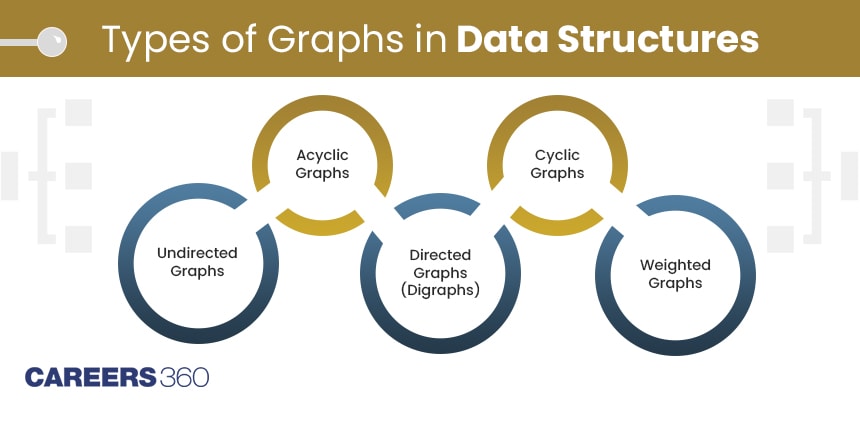
These visual depictions help understand theoretical constructs, finding practical application in fields such as social networks, web structures, and transportation systems. You can also have a look at some of the Computer Science Certification Courses listed on our website.
Also Read:
Graphs in data structure are a visual representation of relationships and connections between entities. They consist of nodes (vertices) and edges that connect these nodes. The relationships between nodes can be directional or bidirectional, forming the basis of various applications. Let us understand this with an example :
In this code we create a graph and create a traversal. The output shows the order in which nodes are visited during the traversal.
class Graph:
def __init__(self):
self.adjacency_list = {}
def add_node(self, node):
if node not in self.adjacency_list:
self.adjacency_list[node] = []
def add_edge(self, node1, node2):
# Assuming an undirected graph
self.adjacency_list[node1].append(node2)
self.adjacency_list[node2].append(node1)
def dfs(self, start_node, visited=None):
if visited is None:
visited = set()
print(start_node, end=" ")
visited.add(start_node)
for neighbor in self.adjacency_list[start_node]:
if neighbor not in visited:
self.dfs(neighbor, visited)
# Example usage:
graph = Graph()
# Adding nodes
graph.add_node(1)
graph.add_node(2)
graph.add_node(3)
graph.add_node(4)
# Adding edges
graph.add_edge(1, 2)
graph.add_edge(1, 3)
graph.add_edge(2, 4)
# Output: 1 2 4 3
print("DFS Traversal:")
graph.dfs(1)
Also Read:
There are several types of graphs in data structures. Given below are the various types of graphs that are used in data structure with examples:
This is one of the important graphs types in data structure. In an undirected graph in data structure, the edges have no direction. The relationship between nodes is mutual, creating a symmetrical structure. Think of it as a two-way street where traffic can flow in both directions.
Example: Consider a social network where individuals are represented as nodes, and friendships are the undirected edges connecting them.
In a directed graph, edges have a direction, indicating a one-way relationship between nodes. It is like a network of one-way streets, where the flow of information or influence is specific.
Example: In a network of web pages, directed edges could represent hyperlinks, guiding users from one page to another.
Weighted graphs assign a numerical value (weight) to each edge. This weight often represents a cost, distance, or some other metric, adding an extra layer of information to the relationships.
Example: This graph data structure example shows a transportation network, with nodes as cities and weighted edges representing travel distances, showcasing the utility of weighted graphs.
Cyclic graphs exhibit cycles, indicating the presence of closed loops or circuits within their structure. Navigating through the nodes can lead you back to your starting point.
In contrast, acyclic graphs have no cycles. They form a tree-like structure, with nodes connected in a way that prevents the creation of closed loops.
A graph data structure is a systematic way of organising and storing graph information in computer memory. It involves defining the nodes and edges, along with any additional properties like weights. This structured representation allows for efficient manipulation and traversal of graphs in algorithms and applications.
Also Read: Top 50 Data Structures And Algorithms Interview Questions
Graph traversal is the process of systematically visiting all the nodes in a graph. There are two primary methods:
Depth-First Search (DFS):
DFS explores as far as possible along each branch before backtracking. It is akin to wandering through a maze, exploring one path fully before considering alternatives.
Breadth-First Search (BFS):
BFS explores a graph level by level, starting from the source node. It is like ripples in a pond, moving outward in concentric circles.
These traversal methods are fundamental in understanding the structure and relationships within a graph.
400+ Recruiters | Highest CTC 17.2 LPA | Average CTC 8 LPA | 92% Avg. Placements | Ranked as Platinum Institute | Awarded Best Business School of the Year
Recognized as Category-1 Deemed to be University by UGC | 41,000 + Alumni Imprints Globally | Students from over 20+ countries
Graphs in data structure are not just a theoretical concept; they are a practical and powerful tool for solving real-world problems. Whether representing social connections, web structures, or transportation networks, graphs offer a visual and intuitive way to model relationships. Understanding types of graphs and their methodologies equips you with the skills to navigate and analyse these complex structures.
Frequently Asked Questions (FAQs)
A weighted graph assigns numerical values (weights) to edges, providing additional information such as distance or cost. This enhances the depth of information in relationships, making it invaluable for various real-world scenarios.
Consider a social network where individuals are nodes, and friendships are undirected edges. This illustrates how graphs in data structure offer a tangible representation of interconnected relationships in our digital landscape.
Graph traversal involves systematically visiting all nodes in a graph. Methods like Depth-First Search (DFS) and Breadth-First Search (BFS) provide insights into the structure and relationships within a graph, playing a crucial role in algorithmic applications.
The types include undirected graphs, directed graphs, weighted graphs, cyclic graphs, and acyclic graphs. Each type brings a unique structure and application to the realm of data structures.
Graphs in data structure are visual representations of relationships between entities. They consist of nodes (vertices) and edges, forming a versatile framework to model connections in various applications.

On Question asked by student community
Hi!
Stay updated on the below page, the computer science link will be made given as soon it is available:
Hello student!
Given below are the link for Class 11 Tamil Nadu Quarterly Question Paper and Answer Key for Computer Science:
Hello Ayush,
For the WBCHSE Class 12 Semester 3 Computer Science Question Paper 2025, you can access the Careers360 resource below. The Semester 3 exams were conducted in September 2025, and the Computer Science paper is available for download.
Hello Student, Pune district mein B Sc . Computer Science ke liye aapko government, aided, autonomous aur private colleges ke options mil sakte hain. College choose karte waqt sirf naam nahi, balki fees, affiliation, accreditation, syllabus, faculty, computer labs, internship opportunities, placements aur location bhi compare karein.
Hello,
To download the 2nd PUC CS Question paper PDF, click on the link given below.
https://school.careers360.com/download/ebooks/karnataka-2nd-puc-computer-science-preparatory-exam-question-paper-2025-26

Globally Recognized by AACSB (US) & AMBA (UK) | 18 LPA Avg. CTC for PGPM 2026
Gateway to IBS Hyderabad & 8 other IBS campuses | Scholarships worth 10 CR
BBA 2027 Early Bird Applications Deadline 30th Sept'26. Apply now using coupon code CAREER250 and get ₹250 off the application fee | 100% Placements with 260+ Recruiters
Last Date to Apply: 17th August | QS I-Gauge Diamond Rated | NAAC A+ Accredited | 621 Recruitment Partners | INR 40 LPA Highest CTC | 4482 Job offers
Among top 6% B-Schools globally to be accredited by AACSB | Highest Package-35 LPA
10000+ Alumni across the globe | Scholarships available